

Many of us experience jaw tension at some time or other. Sometimes it becomes chronic and can manifest as clenching or tooth grinding (bruxism) during the night. The latter produces wear on the teeth and mechanical stress on the jaw joints (the temporomandibular or TMJ joints), one or both of which can become inflamed, painful, and subject to wear and tear (osteoarthritis). A painful or irritated TMJ joint actually increases the jaw tension on the same side, and can cause headaches, facial pain and lead to neck tension and pain. As I said, many of us experience this, particularly during stressful times. I have myself, so I have become a bit of an expert in what to do about it.
First of all we need to realise that in most cases jaw tension and bruxism are stress-related. The jaw muscles, along with the shoulder, upper back and neck muscles naturally tense up when we are stressed. So if the jaw tension is chronic or frequently recurrent, it is not going to go away for very long so long as we remain stressed. Now, stress is not the things that happen to you (those are the stressors), stress is how your body, mind and emotions respond and feel when challenging things happen to you.. To get less stressed you have four options. They are the 4 As:: Avoid the stressful situation, Accept it, Alter it or Adapt to it. The last one means to change your responses. All of this is covered in detail in my book, Stress: Survive and Thrive. One thing is certain: If you don’t de-stress, your jaw tension will likely stay with you. However, there are things you can do to diminish the problem and/or its impact.
If the issue is chronic, it is a good idea to see your dentist and ask him or her to have a bite guard made for you. This is a protective device made from a special kind of plastic which you fit onto your teeth during the night. It won’t stop you from clenching or grinding, but it will save your teeth and absorb some of the force so the TMJ is put under less pressure.
But what can you do to reduce the tension and the clenching or grinding? Several simple things. Here are some suggestions:
- Put a few drops of essential oil of lavender on your pillow at night. Lavender is a natural relaxant both of the nervous system and of the muscles.
- Take a herbal tea or tincture that promotes relaxation. There are many relaxant herbs and different people respond differently to each of them, so a little trial and error is needed. Some to try include valerian, passion flower, california poppy, lemon balm, sweet clover, hops and skullcap. Chamomile though, maybe because it is so common and well-known, is possibly the most underestimated herb! Personally I find a cup of strong chamomile tea before bed to be as good as anything. But do not take herbal relaxants if you are on any kind of medication for anxiety or insomnia, and always consult a health care practitioner before starting on any new herb.
- Get some open air exercise on a regular basis, preferably every day. A daily 30 minute walk at a brisk pace is a good start.
- Take up meditation, yoga or tai chi. All of them are anti-stress, helping with mind-body relaxation.
- Practise slow abdominal breathing for 5-10 minutes a day. Here’s one simple breathing exercise. It is done lying on your back on your bed, or on a rug, carpet or exercise mat on the floor. Your legs can be stretched out flat, but it is sometimes more comfortable to have your knees bent, resting inwards against each other, feet placed slightly apart on the surface you are lying on. Otherwise, put your knees over two pillows. The exercise is best done with your eyes closed. In fact, you will be breathing with your diaphragm, it just feels like the abdomen. You need to learn to use your diaphragm more and your chest less. Rest one hand lightly on your tummy. Relax your tummy muscles and feel your tummy expand as you take an in-breath. Take a few in-breaths like that to get the feeling. What are your chest and shoulders doing? Are they rising on your in-breath? They shouldn’t be moving very much. If your chest and shoulders are rising when you breathe in, mentally relax them, and mentally inhibit them on your in-breath. After the first few sessions you will no longer need to rest one hand on your tummy, but you will need to check up on your chest and shoulders from time to time. Do not focus on making your breathing deeper, or you will make it too deep, which is counter-productive. Focus on making it slower. Then it will also get just a little deeper naturally, but in the right measure. Don’t make it very slow, just a little slower than normal. In normal quiet breathing, no effort is required to expel air from the lungs (in contrast to inhalation, which depends on muscular action to suck air in). The thoracic cage is elastic, and this elasticity provides the rebound energy to expel the air without any muscular effort.
- Do the following jaw-balancing exercise once in the morning and once before bed:
- Open your mouth half way.
- Hold your chin with the index finger and thumb of both hands.
- Push down on your chin with your fingers without allowing your head your jaw to move i.e. you resist the force exerting by your fingers with an equal force with your jaw and neck muscles. The force used should equate to about a quarter of the strength of your jaw muscles. Do this for 5 seconds.
- Now push do the same pushing upwards with your thumbs for 5 seconds.
- Do the same pushing to one side for 5 seconds and then the other.
- Repeat this series of resisted efforts 3 times.
- Immediately after the third series, open your mouth as wide as possible, helping with your hands, and stay like that for 10 seconds.
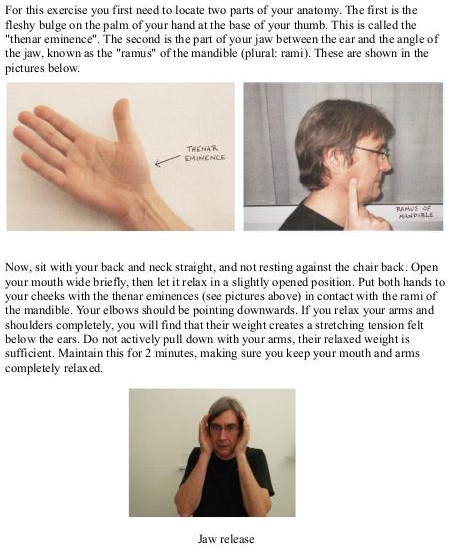
- Do the following jaw-relaxation exercise (from my book Stress: Survive and Thrive) after you have done the previous exercise:
Still having trouble after having tried all these self-help suggestions? Consider having osteopathic treatment and/or acupuncture. Both can help to reduce the muscle tightness and more. They both have their particular advantages. In addition to reducing the muscle tension, osteopathy helps to resolve any structural alignment issues, while acupuncture can calm anxiety and help against stress.
Copyright © Robert Hale 2025.
Photo at head of page by Mohamed Hassan form PxHere..
 Robert Hale