
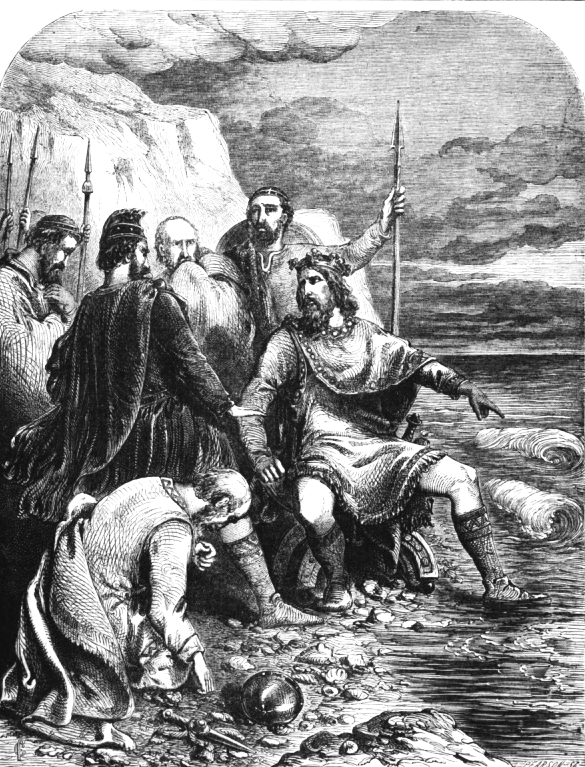
King Canute (Cnut the Great), the 11th-century Norse ruler of England, Denmark, and Norway sat by the shore and commanded the tide to stop, but the waves ignored him. This was not arrogance – rather, he was demonstrating to his courtiers that even a king’s power is limited.
I would not compare myself to that wise king or any king, but sometimes it seems that in common with other conscientious osteopaths, I am engaged in a futile attempt to stem a tide. Of ignorance. The ocean of that commodity is just too great, and the waves are lapping at our feet and advancing. The specific thing that I write of is what this discipline is all about, this discipline that is becoming ever more popular, my profession (one of them), about which I care. Despite its growing presence in the awareness of the general public, there are still gross and persistent misconceptions about it. Let me explain.
A lady patient of mine with a hip problem went to see an orthopaedic specialist. She went to see him because I had suggested she get a scan, and where I live this is a necessary step in the protocol. And this orthopaedst, on learning that she was seeing me, said to her, «Oh, but if you’re going to an osteopath, he should crack your joints, you’ve surely got something out of place». Well this is a sensible lady who I have helped recover from a serious pain condition in the past, and she does understand what it is all about, so she just replied, «No, I don’t want him to do that». Now, this is a doctor, you understand, so he has gone through many years of learning and training, and knows his anatomy, physiology and pathology, and so should know that painful musculoskeletal conditions are not commonly caused by things being «out of place». That is an outdated idea from a century and a half ago. Yet (and this is just my supposition from knowing a little bit about this man) as he is quite open-minded and because he believes (erroneously) that this is what osteopaths believe, he allowed himself to say something so incorrect and inappropriate to this lady. I should tell you he is also a surgeon, and to say that it would be like my telling him which knife to use would understate it by quite a lot; actually it would be like my telling a patient of his, «Oh, you’re seeing an orthopaedic surgeon, he should cut you open, you’ve surely got something which needs taking out or replacing». It really is that gross!
I remember too, a male patient who came to me once (only once!). He wasn’t satisfied with my treatment. Afterwards he told me, «I was expecting you to manipulate me». I replied, «I’ve been manipulating you for the past half an hour. Then he said, «But I know a good osteopath makes your bones go crack». So I told him that he had better go find a «good» osteopath. And similarly with a female patient who told me she had been expecting osteopathy. When I asked her what she meant she said she wanted her back cracked.
Where on Earth does this bizarre idea come from?!
The man who developed the art and science of osteopathy was a 19th century doctor and surgeon by the name of Andrew Still. His name is revered by osteopaths. From the material I have seen, he rarely if ever used techniques which made the joints crack,. His techniques were quite gentle, and if the joints produced a sound it was merely a by-product, nothing of significance. And I follow his example. This is what Dr Andrew Still had to say about that particular matter:
One asks, “how must we pull a bone to replace it”? I reply, pull it to its proper place and leave it there. One man advises you to pull all bones you attempt to set until they “pop.” That “popping” is no criterion to go by. Bones do not always “pop” when they go back to their proper places nor does it mean they are properly adjusted when they do “pop”. If you pull your finger you will hear a sudden noise. The sudden and forceable separation of the ends of the bones that form the joint causes a vacuum and the air entering from about the joint to fill the vacuum causes the explosive noise. That is all there is to the “popping” which is fraught with such significance to the patient who considers the attempts at adjustment have proven effectual. The osteopath should not encourage this idea in his patient as showing something accomplished.
I do not encourage that idea in my patients as showing something accomplished.
Some people really want there joints cracked and others absolutely do not want it. Most though, really don’t care, they just want to get better. As a therapist one attracts and nurtures the kinds of patients best compatible with one’s own disposition. Those who just want to be cracked will go elsewhere and those who actually want to improve their health long-term will do so with me through the artful application of osteopathy. That is what real osteopathy is all about.
I cannot stop the tide. But I can swim. Maybe the tide will go out again. So far as educating about osteopathy is concerned, this article will constitute much much less than a drop in the ocean, but if even one person learns something from it, it will have served a purpose.
Artwork: King Canute reproving his courtiers. John Cassell, Public domain, via Wikimedia Commons.
 Robert Hale