
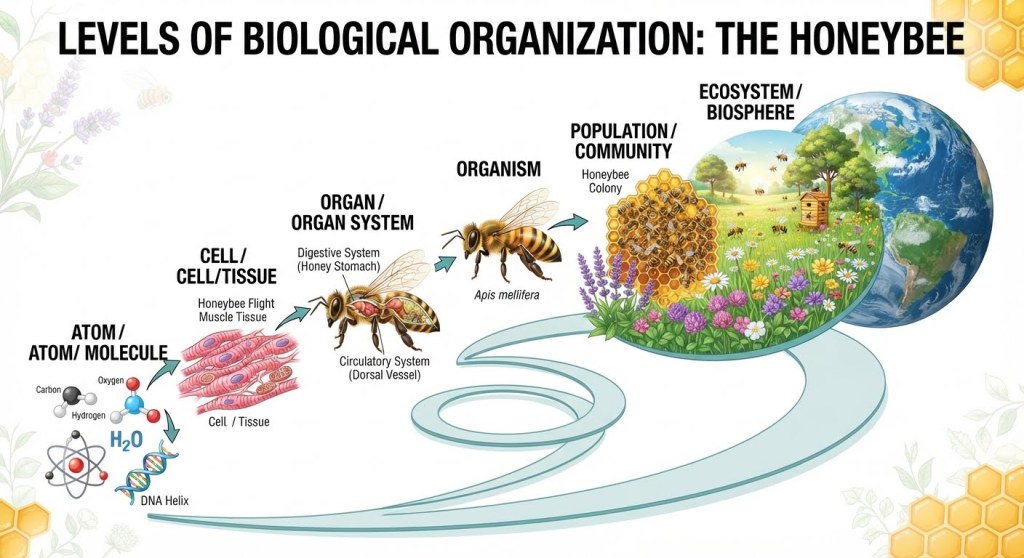
Biological life has levels, or layers, of organisation. One is the organism, another is the community. Above the community is the population and then the species. Below the organism is the organ and then the organelle. And the layers extend virtually to infinity.
You can go sideways too. For example above the species level we climb along the branches of an upturned tree through all the levels converging to family and on further through to biological kingdom, always onward and upward. But in another direction of thought we have the ecosystem and biosphere (the global togetherness of ecosystems).
All of these are categories produced by human thought in order for us to make sense of life on Earth. The deviate just briefly, any noun you can think of – anything at all – is code for a discrete human concept. You might use the word «just» in that last phrase. Except we could not communicate without them, nor think at all in normal human terms.
But back to the levels of organisation. You could take any one of them, say a single bee (an organism) or a colony or swarm of bees (a community) to take one example, and say, «this is the main thing, this constitutes what we must consider the unitary whole, we can only talk of bees in terms of this». But you cannot, because there are levels above the colony and below the organism. You may decide that you have a special interest in one level, and so you specialise, this becomes your whole. Thus we have microbiologists and among them virologists, zoologist and among them herpetologists, and so on. You may instead not wish to limit yourself so narrowly, and instead study ecology or systems biology or even philosophy. Or you may decide that even philosophy is too tied up with concepts and labels, and pursue a spiritual path. It’s all good, all useful.
So neither the organism or the community is a «whole» in the sense that neither can function in isolation, divorced from the levels above and below. These levels and layers form a unified system (entity even) that extends outward beyond the confines of this Earth to the farthest boundaries of the universe, and inward to the tiniest yet-unknown sub-atomic wave-particles.
Taken together, it is a beautiful «landscape». Or it is a wonderful, never-ending, multi-dimensional tapestry embroidered with the most amazing, endlessly varying patterns of sumptuously coloured silks. In some places there is greater density of patterning forming distinct nodes, but everywhere all is unified by a background wave of colour.
Coming back from this figurative description, to speaking using our «code» of concepts, to regard any one part of the system/entity as the main thing, the whole, is not a holistic view. A holistic view attempts to «see» the entity or system from the macro, generalist viewpoint, as well as the micro, detailed point of view. The physical and functional connections between micro-elements within, that make up any system/entity, are just as important for understanding as a view of how that system/entity relates to others to form something greater than itself. When we add the time dimension, the picture becomes even more intriguing. But I will leave it with that one sentence.
To gain understanding one must cultivate and hone an ability to zoom in and zoom out at will, in order then to integrate both, no, multiple views into whatever one is attempting to achieve. I have done this throughout my professional life, and I am still honing my skill in this regard.
Image: AI.

